When Does Gatsby Meet Daisy When Does Gatsby Meet Daisy Again
2 Opinions: Did Gatsby Beloved Daisy?
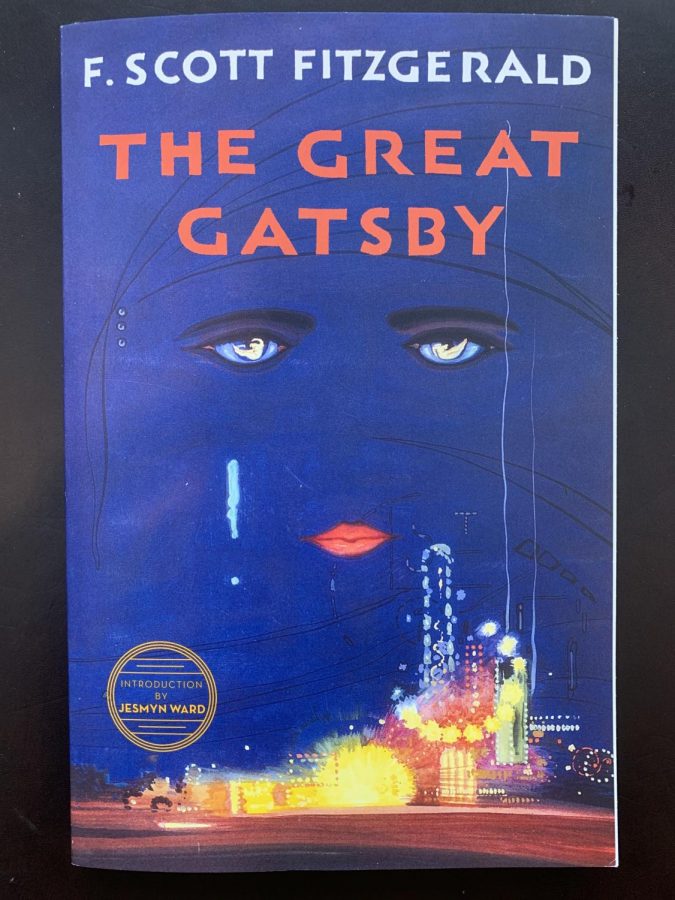
Photograph by Peter Ryan '21
In The Dandy Gatsby past F. Scott Fitzgerald, the mysterious and nouveau riche Jay Gatsby badly attempts to rekindle his past romance with Daisy Buchanan, a beautiful and charming socialite, on Long Island at the tiptop of the roaring twenties. Although Daisy accepts Gatsby'southward advances and temporarily reignites their human relationship, she refuses to go out her upper-class hubby Tom. Somewhen, Fitzgerald reveals that Gatsby, who grew upwardly every bit a poor farmer's son in North Dakota, constructed his entire identity and personality around returning to Daisy after coming together her as a young human being before leaving to fight in World State of war I. This archetype American novel tells the story of a human being who loses his sense of cocky after falling deeply in dear for all the incorrect reasons. Seduced by Daisy's refined manner and extravagant lifestyle, Gatsby affixes himself to her like a virus. The reader'southward impression of both Gatsby and Daisy is formed through the optics of the novel'due south narrator, Nick Carraway. Nick, a reclusive bail trader and Daisy's cousin, editorializes frequently and criticizes the profligate and selfish nature of the other characters. Nick does express skepticism almost Gatsby's feelings for Daisy. However, he himself admits that his account of Gatsby is highly biased: "[he] represented everything for which I have an unaffected contemptuousness" (2). Additionally, Nick is a highly unreliable narrator: indeed, he begins the novel by declaring that he is "inclined to reserve all judgments" (i) before spewing ix chapters of conclusions about others. Nick'southward predictions about Gatsby'due south and Daisy'south feelings cannot be trusted; but the basic events of the story that he sees in real-time can exist taken as fact. According to the Buchanans' friend Jordan, Gatsby and Daisy met in Louisville in 1917 when Gatsby was an enlisted soldier and Daisy was 18 years old. During this time, the two saw each other frequently — Jordan notes that although Daisy made dates with many young men, she held special affection for Gatsby, who "looked at her the mode all young girls want to exist looked at sometimes" (75). On one of these dates, the two shared a kiss, which Nick alleges "forever wed [Gatsby'due south] unutterable visions to her perishable breath" (111). Before long after, Gatsby was called to war, and Daisy before long married Tom. Notwithstanding, once Gatsby returns to the United States, he devotes his life to winning Daisy dorsum. Through shady business dealings, he earns a small fortune, with which he purchases a massive mansion beyond the bay from the Buchanan estate. At night, Gatsby wanders out to the shore and stretches his artillery in the direction of a light-green lite at the terminate of Daisy's dock. Eventually, through Nick, Gatsby meets Daisy once more, and they begin to visit each other frequently. His actions are deranged, desperate, and perhaps mercenary, only his devotion to reclaiming this by romance is unequivocally 'dear'. Subsequently a tense and confrontational evening out in Manhattan with Tom and Jordan, Daisy and Gatsby drive back together to Long Island in Gatsby'southward automobile. Backside the wheel, Daisy strikes and kills a woman standing in the road. Earlier this fact is revealed, though, Gatsby assumes responsibility for the manslaughter in order to protect Daisy. When Nick asks Gatsby if Daisy was driving, he dismissively says: "aye, but of course I'll say I was" (143). Gatsby proceeds to fervently excuse Daisy'due south recklessness. The next 24-hour interval, the widower of the machine blow'due south victim murders Gatsby. Tragically, Gatsby feels so obligated to protect Daisy that he literally takes the bullet for her. Although Gatsby may love Daisy more for what she represents than for who she is, this deed of effectively sacrificing his ain life to salvage hers tin can simply exist characterized as love. Daisy Buchanan's character takes direct inspiration from the 20th-century socialite Ginevra King, who dated Fitzgerald during his time at Princeton. After meeting at a sledding party, King and Fitzgerald rapidly adult a passionate correspondence; in 1 letter of the alphabet, King confessed that she was "madly in love with him." However, due to Fitzgerald's lower social status, Rex'due south parents forbade the human relationship: her begetter reportedly told Fitzgerald that "poor boys shouldn't think of marrying rich girls." Despite intense affection, these challenges eventually dissolved the relationship. Co-ordinate to 1 friend, "Fitzgerald was and then smitten by Rex that for years he could not think of her without tears coming to his optics." By all accounts, the failed romance was a classic example of forbidden beloved. Those who believe that Gatsby never truly loved Daisy argue that he was more than obsessed with the hope of condition she provided. However, Fitzgerald'south own life, which serves as the basis for the story, proves that such a love tin can exist. Fitzgerald's 3 well-nigh renowned works — Gatsby, The Beautiful and Damned, and This Side of Paradise — are bound together by themes of materialism and yearning for ultimately unattainable dreams. In each of these novels, massive fortunes and beautiful socialites stand as representations of the American dream. For this reason, information technology may exist impossible to debate that Gatsby did or did non love Daisy Buchanan; they aren't existent people. Rather than real humans with human emotions and costless will, Gatsby and Daisy are pawns in an allegory of the greed and excess of the 1920s in the United States. After all, The Not bad Gatsby is merely a book. Its characters do not exist beyond the 180 page description that Fitzgerald provides. The Keen Gatsby by F. Scott Fitzgerald tells the story of the hardworking and driven Jay Gatsby as he claws up the ladder of social grade during the summer of 1922. As it is revealed throughout the novel, the sole purpose of his efforts is to proceeds the affection of his past lover Daisy Buchanan, whom he deserted five years before to go to war. Despite Gatsby's "romantic readiness" (2), as narrator Nick Carraway puts it, he subtly shows that his beloved for Daisy is never 18-carat. Gatsby, in fact, is never capable of loving her at all; he was born with a life and condition too drastically unlike from hers to e'er actually connect with her in a true, romantic way. Rather, he loved the thought of Daisy and what she stood for. In chapter 6 of the novel, Nick narrates the story in which Gatsby rose from being a poor teenage son of farmers in N Dakota to working for self-made millionaire Dan Cody on a yacht. Gatsby goes through an extreme identity modify in this chapter, changing his name from James Gatz to Jay Gatsby and "[springing] from the Platonic conception of himself" as the "son of God" (98). In this scene, he falls into and climbs out of a lake with a new sense of self and burning passion to become rich. Although this identity transformation occurs before he has fifty-fifty met Daisy, it shows the moment that substantially defines the sole motive of his life, and it is clearly non finding beloved. Later in this affiliate, Nick tells the story of Gatsby and Daisy's beginning kiss, which demonstrates Gatsby's subtle understanding of the superficiality of their relationship. "He knew that when he kissed this girl, and forever wed his unutterable visions to her perishable jiff, his mind would never romp once more like the mind of God. So he waited, listening for a moment longer to the tuning-fork that had been struck upon a star. And then he kissed her" (111). Gatsby feels that the rich and classy persona he attempts to embody should love someone similar Daisy, a high-course, bonny, and intriguing young woman. Just that'southward just the event – it'southward solely the idea of her that he chases so fervently. He even understands that kissing her is "[wedding] his unutterable visions to her" and limiting the expansiveness of his mind and dreams. This isn't dear; it's responsibility, following expectations, and doing what it takes to reach a item identity of his own. Even Gatsby, who is so defenseless up in his infatuation, has to accept a moment earlier he kisses her, realizing how inevitably painful this action is. In the next chapter, Gatsby, Daisy, Nick, and a few others have a dinner party at which Gatsby notes the post-obit: " 'Her voice is full of money' " (120). Nick and so realizes: "That was information technology. I'd never understood earlier. It was full of money–that was the inexhaustible charm that rose and roughshod in it, the jingle of it, the cymbals' vocal of it… High in a white palace the king's daughter, the golden daughter…" (120). Despite Gatsby's attempt to play the part of her secret, long-lost love, even he tin't help only notice how much her entire persona exudes money. Though he constantly pretends that he sees past this and chooses her for her, this passage reveals that his teenage transformation and quest for wealth never faded, and they continue to ascertain the course of his entire life. Her classy, flashy image is exactly what a 'man like him' should want, so he picks her and rolls with information technology, struggling with the internal turmoil of understanding that he does non and volition never love her authentically. Lastly, when Nick confronts Gatsby for trying (and declining) to impossibly recreate their past relationship five years prior, Gatsby is stunned: " 'Can't repeat the past?' he cried incredulously. Why of course yous can!' He looked around him wildly, as if the past were lurking hither in the shadow of his house, just out of attain of his paw" (110). His obsession with "the past" is very telling of how superficial his love is — he can't even create new memories and connections with Daisy. Instead, he grasps onto the precious time he once spent with her years ago hoping that this is enough, but inwardly knowing that information technology never volition be. Furthermore, his oblivion and unwillingness to confront the truth show that deep downward, he understands that loving her and manufacturing a relationship are but not possible for him. Notwithstanding, without her clutching the wealth and status he infinitely seeks, he has no goal to chase, and feels completely lost; to recoup, he just chases later something that isn't there in fear of finding himself purposeless and insignificant.Yes – Peter
Gatsby might honey Daisy for all the wrong reasons, but that doesn't mean he doesn't love her. His manic desire to conjoin his existence with Daisy's certainly doesn't fit the idyllic and reciprocal formulation of "truthful dearest" that exists in perfect endings, merely this is role of the brilliance of The Great Gatsby: it is brutally and uniquely honest about the fact that people, their motivations, and their relationships are securely flawed. Gatsby's honey for Daisy is deeply flawed: it drives him insane, uproots his life, and literally brings him to decease. All the same, beloved is the only style in which anyone could describe the unshakeable affection and obligation to protect that Gatsby feels for Daisy.No – Margot
Daisy is solely a manifestation of Gatsby's life goal, and can be zip more — he is incapable of really loving her because, equally he decides as a teenager, course ascent and wealth obtention are the only things he truly ever seeks. Daisy presents as a convenient physical embodiment of these ideas, and so Gatsby settles for a meretricious infatuation to consume his fourth dimension, efforts, and thoughts, never allowing himself to fifty-fifty remember that she isn't the perfect woman for him.
toneysumbracked1957.blogspot.com
Source: https://fssfalcon.org/3944/opinion/two-opinions-did-gatsby-love-daisy/
0 Response to "When Does Gatsby Meet Daisy When Does Gatsby Meet Daisy Again"
Post a Comment